4
Active peptides
Four peptides. One vial. For people who get paid to take the hit.
Request information →What is BPC Matrix?
BPC Matrix is a four-peptide blend in a single vial — BPC-157 (10mg), TB-4 (2.5mg), KPV (2mg) and MGF (1mg), 15.5mg total. It's made in the USA and available through licensed physicians only. The peptides are supported by preclinical research; none is an FDA-approved drug.
The part nobody sees
Nobody tells you it's over.
There's no doctor, no scan, no moment.
You just start warming up a little longer. You start picking which sessions you go hard on. You start saying "I'm good" when you're not.
And one day you realize you've been managing your body instead of using it.
That's the injury. Not the tear. The managing.
You've still got the engine. You've still got the fight in you. You just don't have the recovery you had at twenty-three — and in your line of work, recovery is the career.
What's in it
Tissue repair involves several different processes. Here are the four peptides in the blend — and what each one has been studied for.
Tendon and ligament have very little blood supply of their own, which is part of why they're slow to heal. BPC-157 is the peptide researchers have looked at in the context of new blood-vessel growth into poorly supplied tissue.
In animal and cell studies BPC-157 accelerated tendon explant outgrowth, increased fibroblast migration dose-dependently, improved cell survival under oxidative stress via the FAK-paxillin pathway, and upregulated growth hormone receptor in tendon fibroblasts. Human data remains limited to small pilot studies.
Repair cells have to physically travel to an injury, and that movement depends on a protein called actin. TB-4 is the fragment researchers have studied in the context of actin regulation and cell migration.
In a rat full-thickness wound model, thymosin beta-4 increased re-epithelialization 42% by day four and up to 61% by day seven versus saline, raised wound contraction, collagen deposition and angiogenesis. As little as 10 picograms stimulated keratinocyte migration two- to three-fold.
Inflammation is a normal part of injury, but when it lingers it can get in the way. KPV is a fragment of alpha-MSH that researchers have studied in the context of inflammatory signalling.
KPV is the 11–13 fragment of alpha-MSH. At nanomolar concentrations it inhibits NF-κB and MAP kinase inflammatory signaling by blocking the Imp-α3/p65 interaction, reducing pro-inflammatory cytokine output. Demonstrated in murine colitis models; no human trials have confirmed these effects.
MGF is a form of IGF-1 the body produces itself under mechanical stress. It's the peptide researchers have studied in the context of satellite cells — the cells involved in rebuilding muscle fibre.
MGF is the IGF-1Ec splice variant, produced under mechanical or hypoxic stress. A synthetic 24-amino-acid C-terminal E-peptide activated satellite cells independently of the IGF-1 receptor. Evidence is rodent and in vitro; one independent lab found no myoblast effect.
Why one vial
| Four singles | BPC Matrix |
|---|---|
| Four separate vials to source, prepare and store. | One vial. |
| You set the ratios yourself. | Ratios fixed at 10 / 2.5 / 2 / 1. |
| Four things to buy, store and keep cold. | One thing in the fridge. |
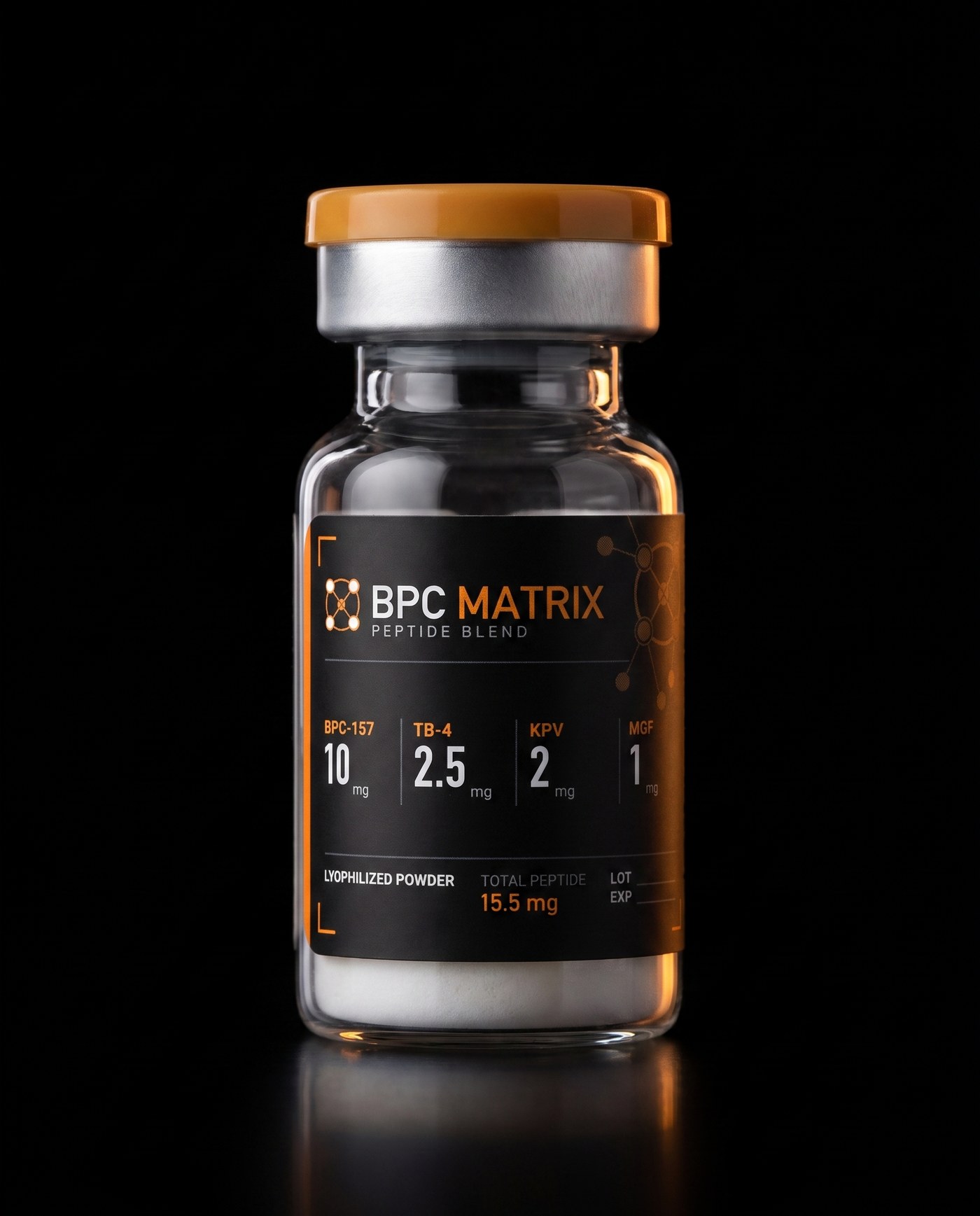
One vial
Lyophilized, sealed, ready to reconstitute. You're not stacking four products and guessing at the ratios — that work is done.
10mg BPC-157 · 2.5mg TB-4 · 2mg KPV · 1mg MGF. 15.5mg total peptide per vial.
Where it's made
A lot of the peptide sold online is imported, and most of the time you can't find out where it was actually produced or what's really in it.
You're injecting this. Not rubbing it on.
BPC Matrix is made in the United States. Wherever you look, ask who compounded it, who's accountable for it, and what testing it's had.
If nobody can answer those questions, that's your answer.
Straight answers
Here's the honest answer: the research on these four peptides is almost entirely preclinical — animal and cell-culture studies. The mechanisms are documented and interesting, but there are no large human trials establishing that they work as a finished product. Anyone telling you otherwise is overselling it. Read the studies, talk to a physician, and decide from there.
Each of the four has been studied in a different context — BPC-157 with blood supply, TB-4 with cell migration, KPV with inflammation, MGF with muscle. The blend simply puts the four in one vial at fixed ratios. It doesn't mean the combination has been proven to do more than the singles — that hasn't been studied. It's a convenience and consistency choice, not a claim of superiority.
There's no reliable human timeline to give you. Soft-tissue healing is slow in general, and the research on these peptides is preclinical — it doesn't establish when, or whether, a person notices anything. Anyone promising you a specific timeline is guessing.
Yes. Assume it is. BPC-157, TB-4 and MGF all sit on the WADA prohibited list, and MGF is a growth factor. If you're in a tested organisation, tested weight class, or an Olympic pathway, talk to your compliance people before you touch this — not after.
BPC Matrix is available through licensed physicians only. It isn't sold direct, and nothing on this page is an offer to sell it.
If this looks relevant to your situation, that's a conversation to have with your doctor.
Four peptides. One vial. For people whose body is the job.
Request information
BPC Matrix is available through licensed physicians only. Leave your details and the team will reach out with the honest next steps — no pressure, no spam.